“The budget in 2024 made life harder for our community; but it has hardened our resolve to fight.”
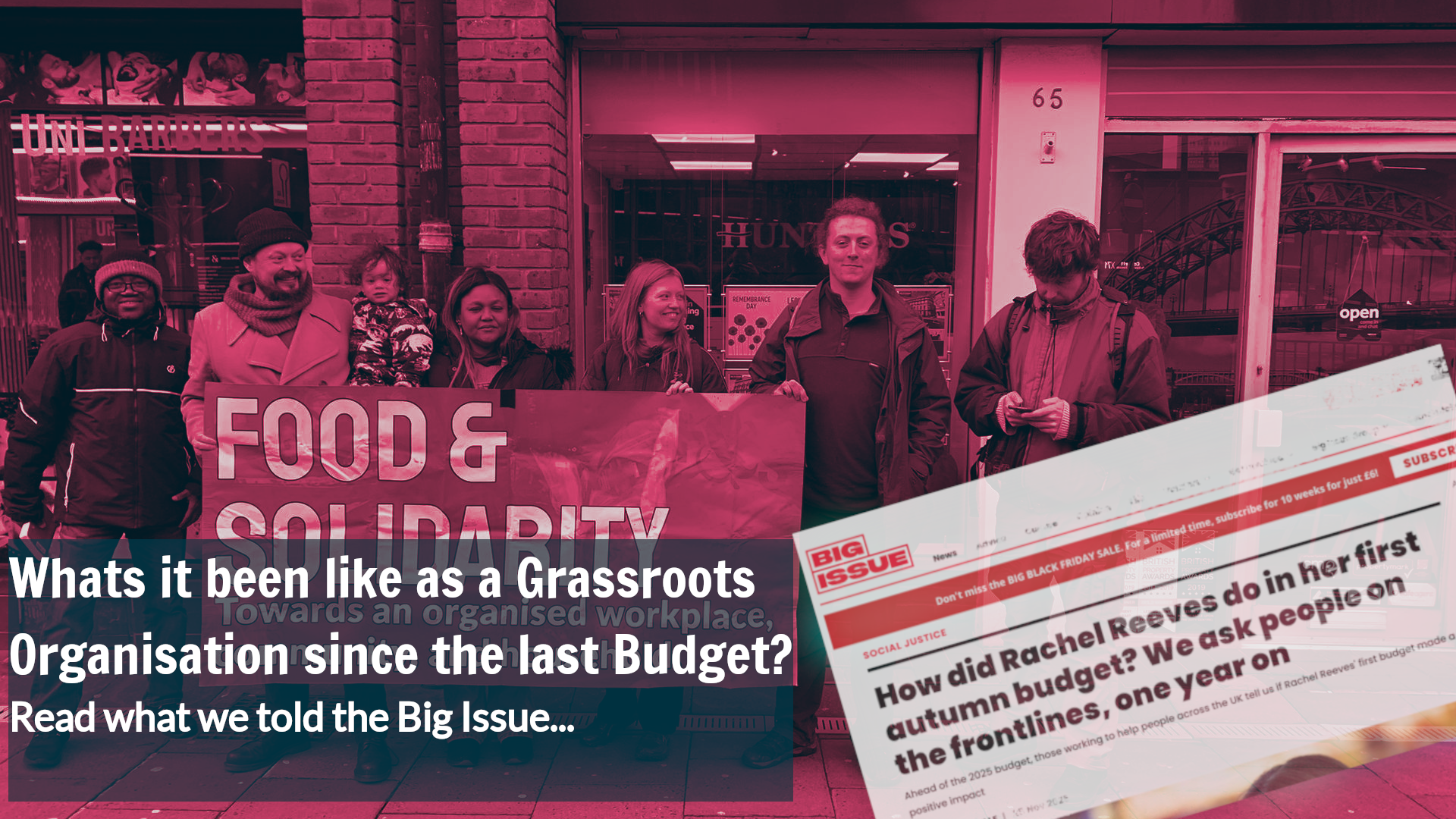
Then Big issue interviewed us to find out what is has been like to be a grassroots organisation since the 2024 Budget. Read the article here, below is the full transcript of what we said.
The last budget has maintained a landscape where our work at Food & Solidarity is both a critical lifeline as well as a testament to the failures to protect us, our communities, and our families. The continuation of the 2 child benefit cap and NRPF, after the last budget has meant 10s of thousands of children spent another year of their life in poverty, completely unnecessarily. The government points to measures like the minimum wage increase. We can see these gains will be immediately erased by rising costs for the people we work with, pushing them into a deeper material crisis. This has directly increased the demand on our work; last year, we distributed over 3,000 food parcels to members, striking workers, and people in crisis. Next year we feel sure it will be more, and the year after more again. Our model is built on solidarity, not charity. We socialise costs and buy at scale to share resources based on self-declared need. But this constant need for emergency food provision, particularly among people who have never needed it before, teachers, health care workers, is a direct indicator of a system that means people live without dignity due to the way systems have been built. In Newcastle Central and West, the constituency in which Food & Solidarity was founded, 43% of children grow up poor. Growing up in these constituencies shortens your life span: growing up poor shortens your life span.
This is starkly visible in housing. Our action at Breamish House, a council-owned block, exposed how local authorities are unable to meet their basic obligations. We found elderly residents like Abdul, Tracey, and Christine, living with collapsed ceilings and black mould, with repairs delayed for months. This is an existential threat to local authorities, especially with Awaab’s Law now in force. The council’s own shock at the conditions we presented reveals the issue: they lack, at the very least, the capacity to make homes safe at a local level, and there is lack of political will to act at the national level. This crisis is compounded by their reluctance to properly regulate private rented sector landlords, as they depend on these same landlords to house the people made homeless by the turbulence of the private rental sector.
In response, we have been forced to try to create political change. Our “No More Growing Up Poor” campaign, included delivery of a photo petition to Labour Mayor, Kim McGuinness, and series of actions outside her office as well as Labour MP for Newcastle Upon Tyne Central and West, Chi Onwurah’s, office, and at cabinet meetings of Newcastle City Council, and successfully pressured McGuinness to back the abolition of the two-child benefit cap. This momentum led to another win: Newcastle City Council voting through a motion we wrote, raised by Green and Newcastle independent councillors, demanding the UK government end both the two-child cap and the No Recourse to Public Funds (NRPF) policy, which passed unamended. This is a crucial step, as these policies deliberately impose managed destitution, with children in our city living on as little as £6.43 a day. Labour councils are falling due in part to this political decision.
Maintaining the No Recourse to Public Funds policy has kept many of these children in poverty, and no changes to benefit caps can save them from the cynical manoeuvres of the political party which some people once trusted to help us. Rather than helping so many families living in poverty by granting them the right to seek support when their children are in need, the Labour Party continues to chase Reform voters with policies that will impose precocity on those in the most need by making them wait 20 years to get Leave to Remain. Such cruelty will not win any Reform voters over to Labour’s side, such people don’t trust Labour and will not be moved by this action to trust them, but will cause immense suffering. They are not lost “Labour voters” despite where they might live, they represent a resurgent Thatcherism, which is focused on how they think they are best able to improve conditions for themselves and their families, however misguided and ultimately doomed to failure this might be.
Ultimately, the impact of the last budget is that it has forced grassroots groups like ours to become the emergency service for a system that only responds when it's threatened, while simultaneously compelling us to build the power to challenge and change that system head-on. The government’s refusal to scrap cruel policies like the benefit cap, combined with its failure to fund local authorities, leaving them unable to ensure the homes we live in are safe, the failure to build publicly owned council homes, so that local authorities might be able to properly regulate the private rental sector. The decision to allow build-to-rent developments to proliferate throughout the brown field sites of the North, and more, all mean we will be here continuing to provide immediate relief in the form of parcels while organising the collective action necessary to win long-term change. The budget in 2024 made life harder for our community; but it has hardened our resolve to fight.