How Newcastle University Workers Won: The 2025 Strike Against Job Cuts
The Newcastle University strike 2025 represents one of the most significant organised labour victories in UK higher education, where staff including lecturers, researchers, and professional services resisted mass job cuts. The strike brought attention to structural challenges in universities such as casual contracts, reliance on international student fees, and the ongoing marketisation of higher education. Through organised industrial action via the UCU, workers forced management to abandon compulsory redundancies, securing hundreds of jobs and inspiring solidarity across the North East and beyond. This account analyses the causes, strategies, and outcomes of the Newcastle University strike 2025, demonstrating how collective action can confront higher education’s systemic inequalities, protect employment, and strengthen worker solidarity. The strike also highlights the broader implications for students, academics, and local communities in England, making this a key case study in successful industrial resistance.
Recent announcements about large scale cuts to jobs in the North East's universities have hit the press and social media in recent months. As universities represent large employers in the region, the matter has been of concern to many. The sheer scale of achieved and proposed job losses across these institutions, particularly Sunderland, Newcastle, and Durham, now appears to be close to 1000. Several of these universities had gone through rounds of voluntary severance already before the recent announcements from university bosses proposing further job losses. This does not just affect lecturers. Professional services workers who keep these universities functioning in countless ways are also targeted for hundreds of job losses.
In addition to this, and sometimes ignored, is the fact that many already precariously employed university teachers (including PhD students) and fixed-term contract researchers have lost work or access to contract extensions very quickly to little outcry. Some of these workers had in the last few years been moved onto practically-worthless 'open-ended subject to funding' contracts, which masked universities' reliance on employment arrangements that can evaporate at a moment's notice.
At Newcastle University, there is both an immediate loss of 300 permanent jobs on the table (staff who would be out of work by the end of July if management get their way) and the proposal by management to cut a further 150 jobs next academic year and further job losses in the year after not ruled out.
Wider context of the UK higher education crisis and Newcastle University strike 2025
This isn't just happening locally. Announcements, both of large scale redundancies and strike action to fight back, have been echoing around the UK for the past year, with 400 redundancies recently announced at Cardiff University and the list keeps growing. Recent analyses projected 10,000 job losses in higher education in England by the end of the 2024-25 academic year. (Collectively, universities in the North East contribute £2.7 billion and 33,500 jobs, a higher output per institution than any other region in the UK, this in the region with the lowest GDP per capita in the UK).
This, many point out, is happening despite tuition fee increases, and in some local cases, despite student numbers still growing year-on-year.
So what is going on in higher education?
Although by no means the whole picture, the failure of international student numbers to continue to rise is a problem. Whilst it's clear applications for student visas have fallen in the UK in recent years, not every university appears to have been hit by a drop so much as some seem to have failed to see increases at the unrealistic rate they banked on seeing. I say banked because these migrant students "who typically pay around three times the annual UK fees", according to the Financial Times, appear to be bankrolling universities (Anyone working in UK HE knows this, the reference is for any who might think this is a hyperbole). In some cases, these high tuition fees are paid by the governments of the students' home countries. UK university bosses have long felt entitled to an ever-increasing and, apparently crucial, foreign subsidy of British institutions in a way that echoes past colonial extraction from many of the same countries.
- Decline in international student numbers: The UK is experiencing a drop in international student applications, which were previously a significant source of revenue for universities.
- High tuition fees: International students often paid three times the fees of UK students, with many governments subsidising the costs for their citizens to study abroad.
- Impact of immigration policies: Stricter visa regulations, higher costs, and restrictions on work rights have made the UK less attractive to international students.
- Outsourcing jobs: To cut costs, universities are outsourcing jobs and opening new campuses abroad in countries like India, Singapore, and Ghana.
- Global exploitation: UK universities continue to extract revenue from former colonies, while the UK benefits economically from international students, often at the cost of academic staff jobs and quality.
Now, some people still seem to think this drop in numbers is just like a natural disaster, rather than the consequences of specific bad policies. Relatedly, such people also think mass job losses as a consequence is reasonable and that there's little point in resisting. For this reason, I would like to lay out another perspective.
Killing the goose that laid the golden egg?
✅ Don't cross the picket line.
✅ Join the picket to show solidarity.
✅ Bring food, snacks, or warm drinks.
✅ Donate to the strike fund.
✅ Help spread awareness on social media.
As some of us can remember, British students paying tuition fees to go to university in the UK is still a fairly new phenomenon, started only in 1998. Many mid- to late-career researchers would not have paid fees to study at university in the UK. What is older is international student fees, which date back to 1969. The policy was part of a raft of racist xenophobic legislation at the time which sought to limit immigration from the colonies to white colonists only (Raji 2022). Steep increases in international tuition fees a decade later were fought back against via tuition fee strikes (ibid.) led by students from former colonies were unsuccessful in beating these back, and they have continued to rise steeply in recent decades.
These same four decades have seen a great deal of xenophobic rhetoric from both major political parties and a barrage of hateful stories in UK media more generally. From the recent endless parade of stories about small boats (which continue to mislead the public about international law and Home Office policies) to prevalent lies about the asylum system which have circulated since the 2000s ('they all get free brand-new iPhones the day they arrive') to propaganda about immigrant misuse of the NHS and misrepresentations of the English test scandal in which students were accusing of cheating.
At the same time successive governments have brought in changes to visa policies that make coming here far more expensive (including NHS surcharges and steeply rising fees to apply for visas) and unattractive (the imposed, and then reversed, cancellation of the automatic right to work full-time for a short period after graduation for those on a student visa). What may have been the final straw was the new restrictions on international students (who are most often postgraduates) bringing their dependents when coming to the UK.
In many ways, it's the same old story, certain people weren't bothered enough to resist and so the UK has experienced decades of xenophobic media and political party messaging whilst seeking to squeeze foreign markets for international students as hard as they could. Many UK academics weren't spurred to action because the xenophobia didn't affect them and they and their institutions were benefitting from the exploitation of former colonies. But, eventually they found it did affect them once the effects hit and damaged the whole HE sector.
There was nowhere near the outcry there should have been in 1969 when fees were brought in, timed suspiciously closely to a period in which international students in the UK and across Europe were powerful political activists. There has also been next to no outcry in recent years (certainly nothing significant in the last 20 years) during which international tuition fees have risen to shocking levels (over £40k a year for some courses). Moreover, there has been no meaningful outcry as the Home Office has taken away the rights of people who would come here as students.
The further threat now looms. Now addicted to extracting money from former colonies to fund their institutions, university bosses are outsourcing more and more UK higher education jobs. This is the logical next step of the marketisation of higher education. They can use the 'good name' of the colonial master to continue to extract from former colonial subjects and stop UK borders from getting in the way of them making money from them. All the while saving money on UK lecturer and professional service staff salaries by hiring overseas. Many such campuses bearing the names of UK-based universities, have sprung up, like poppies, on land damaged by past British imperial violence and control, in China, Malaysia, Singapore, Dubai, Ghana, among others.
Making the link between job losses here and new campuses elsewhere, as staff at Newcastle University received information from management about the job losses already in progress, its Vice Chancellor, Chris Day OBE, who is Chair of the Russell Group, appeared in India announcing that he was seeking to open a new campus of Newcastle University there.
Why should you care? - The Scale of University Job Losses
Workers on strike stop doing their jobs to pressure employers for better wages, conditions, or job security. They often form picket lines to prevent business as usual. Since they don't get paid while striking, they rely on community support, such as donations and strike funds.
UK Higher Education institutions represent a large part of the UK workforce. With more than 500,000 employees across the UK, they are among the largest employers in the UK, behind the NHS and grocery stores. Having large numbers of people out of work in the UK is bad for all of us. Since so many universities have hiring freezes and are making redundancies, large numbers of people losing their losing jobs now will struggle to find new jobs that match their skills. This is especially true of academics, for whom moves into other areas of the public sector (NHS, local government, the third sector) are less realistic than they were 15 years ago. What I mean is these kinds of shake ups affect everyone eventually, the number of people in the North East who will be out of work if uni bosses in the five northeast universities get their way is too large for us to ignore and will affect our communities, one way or another.
Moreover, allowing bosses in any sector to treat people as disposable isn't good for us. Higher Education is one sector in which casualisation has taken root quite deeply, fuelling a culture of disposability for higher managers who de-risk their institutions by maintaining the ability to shed hardworking people. Other sectors (e.g. retail, media, and transport) increasingly have rendered their workforces precarious and with leaders and managers acting as members of boards of trustees and directors across different sectors, bad employment practices can easily spread and become embedded.
For this reason, resisting changes that harm one group of workers can help others in the community and working in other sectors, like a rising tide that lifts all boats. This is why when workers' resistance to harmful changes to contracts, pay, equality, pensions, or working conditions (all of which have been on the decline in the UK) escalates and take the form of strike action, you often see other trade unions come out to support the picket lines (the CWU deserve special mention for being so stalwart in this) or refuse to cross picket lines to do business at the workplace where worker are on strike.
What happens when workers go on strike? Why University Workers Are Striking?
- Nearly 10,000 job losses projected in UK universities by 2025
- Casual contracts leave teaching staff with no job security
- Universities rely on international students' high fees but face declines
- Public funding cuts are shifting costs onto students & workers
- Soaring workloads, jobs are lost while teaching more or less the same.
Strikes are one form of resistance, a type of industrial action, in which a group of workers who are in a trade union refuse to do their jobs as a way to force employers to change something, whether it's them being harmed in the workplace or any other important issue. Workers often also set up picket lines to disrupt the workplace and, at times, to stop anyone entering so that business cannot carry on as usual. People on strike do not get paid for the period when they are striking, so they are always making a big personal sacrifice to create change. Strikers often worry about how they will feed themselves and their families or manage to pay rent or mortgages with the loss of pay. There is always a risk of being starved back into work and losing ground on the important problems they are fighting back against. It can be a frightening experience to go on strike, and the experience of intimidation from managers or from workers who chose not to participate in strikes are not uncommon.
Striker Solidarity Parcel request form.
How You Can Support Striking Workers?
There are many ways people who are not involved in the dispute can support striking workers. Not crossing picket lines is a big one. Those picketing often cheer loudly and feel hope when people see the picket line and clearly decide not to cross it. Any visible shows of support for strikers make a positive difference to morale. Some people visit picket lines to add to their numbers or bring striking workers warm drinks or snacks. In one recent example, a visitor engaged in brilliant street theatre lampooning higher managers, which made everyone laugh and (hopefully) made management uncomfortable.
Unions on strike often accept donations from both members and non-members to their strike funds, which can offset the loss of wages (sometimes just a small fraction of the salary, but every little helps). Some unions, like the University and Colleges Union, often prioritise those on lowest wages or least secure contracts in making payments from the strike fund, so that those who have the least can be least affected.
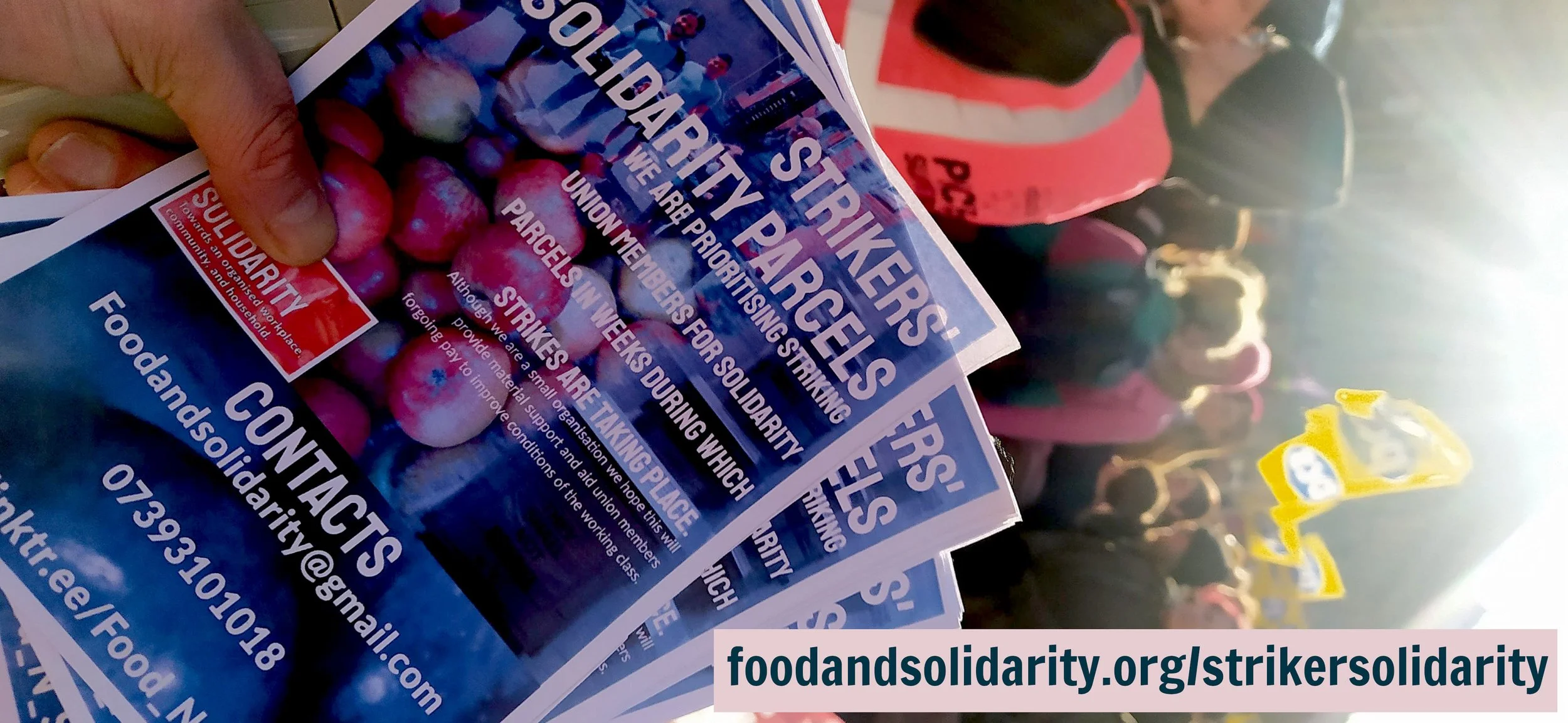
What we do in Food & Solidarity is offer free food parcels to striking workers. We hope this support means people on strike don't feel as worried about starving and can use the money they have for other things, since some of the cost of food is covered. We do this because we know that when striking workers win, we all win.
UCU branches have in the past made donations of money to us to support us in buying food to offer striking workers, including their members, knowing they were going into a period of strike action.
By joining Food & Solidarity, you join a community in which we support one another and those who fight for their rights. Sign up now—when workers win, we all win!